Wednesday, 12 June 2013

Summer BBQ recipes

With summer finally upon us (with the exception of today's stormy conditions!) it's time to dust down the BBQ and do some cooking alfresco! This year we've upgraded to a gas BBQ which in my humble opinion is easier to cook on than charcoal as you can maintain and regulate the heat a lot easier. Below are some easy to follow recipes that definitely have the 'wow' factor and will impress your guests should you be having any round!

Charred asparagus with lemon and sea salt


Ingredients (serves 4)
16 asparagus spears
2 lemons
Sea salt crystals
Splash of olive oil

This dish is as simple as it sounds. Simply chop the wooden bit off the asparagus spears put them in a dish cover with the juice of the lemon, olive oil and salt. Leave for about 30 mins then grill them on a hot BBQ turning frequently to ensure they get an even colour. When they look a bit like the picture above they're ready to serve!

Rib-eye steak with a Dijon mustard and garlic herb glaze


Ingredients (serves 4)
4 rib-eye steaks
4 tsp Dijon mustard
4 garlic cloves crushed
1 small bunch of flat parsley chopped
4 sprigs of thyme
Salt and pepper for seasoning
Olive oil

In a bowl mix together everything but the steaks. Mix well then brush it onto the steaks and leave to marinade. If you can give it 12 hours great, if not then a minimum of 30 minutes will do. Make sure your BBQ is nice and hot then start cooking your steaks. Blue-1 minute each side, rare-1 1/2 minutes each side, medium rare-2 1/4 minutes each side and medium-well done 2 1/2-3 minutes each side. Leave to steaks to rest for a couple of minutes then serve!

King prawn and chorizo kebabs marinaded in olive oil, garlic and parsley


Ingredients (serves 4)
8 large king prawns de-veined (trail of nastiness along it's back)
8 thick slices of chorizo
1 tbsp chopped parsley
4 garlic cloves crushed
Splash of olive oil
4 wooden skewers

Again another simple one! Mix together the garlic, olive oil and parsley and pour over the prawns and leave to marinade. Like with the steaks 12 hours is great but if not then 30 minutes will do. To stop the wooden skewers from burning let them soak in water over night. If that can't be done then pour boiling water over them leave for 15 minutes then repeat with another lot of boiling water. Skewer the prawns and chorizo and start cooking. Be careful not to burn them with the oil that the chorizo will release. When the prawns are pink they're ready, time to serve!

Lamb kebabs with a Greek yogurt and Harissa marinade


Ingredients (serves 4)
4 lamb steaks diced
200g Greek yogurt
2 tbsp chopped mint
2 tbsp chopped rosemary
2 tsp Harissa paste
2 cloves of garlic crushed
Salt and pepper for seasoning.
4 wooden skewers

Mix together all the ingredients except the lamb and then mix the lamb in. Again a long period of marinading would be good but not absolutely necessary. Thread the lamb onto the pre-soaked skewers and then straight onto a hot BBQ. If your BBQ has a lid then close it for 5 minutes to get it extra hot. When the lamb feels firm to touch (after about 5 minutes) then it's ready. Serve it with tzatziki and enjoy!

Wednesday, 27 March 2013

Easter recipes #2


Roast leg of lamb

With Easter on the horizon it's time to get thinking about Sunday lunch. The last blog was a relatively easy recipe allowing you to spend time with your family, this one is a bit more 'hands on' but the rewards are worth it. A roast dinner is a simple dinner to put together as long as all the prep work is done in advance. Below is a step by step guide that will hopefully make things run smoothly.

Ingredients (serves 4)
1 leg of lamb
1 bunch of rosemary
3 garlic cloves peeled
6 medium sized maris piper potatoes
Vegetables of your choice
Goose fat
Good quality gravy thickener
Salt and pepper for seasoning
Olive oil
Splash of red wine

Method
First get your oven to 220C and start peeling your vegetables (this can be done a few hours before) and keep the peelings. Put all the peelings and any bits of root vegetables (not the potatoes) you're not using in a sauce pan with a splash of oil and fry for a minute then add the red wine and let it simmer for 2 minutes to burn off the alcohol. Pour in some water (to fill about 2/3 of the pan) and leave to simmer (this will be the stock for the gravy). Peel the potatoes and cut them into roast potato size and leave them in water. Put the leg on lamb in a roasting dish, pour on a little of the olive oil. Make a few cuts into the meat and stuff them with the garlic cloves, season then place some sprigs of rosemary over the meat.

Leg of lamb ready for the oven
Place the lamb in the oven, after 10 minutes take it out, cover it in foil then put it back in the oven for an hour and a half or 2 hours if you prefer it cooked through. In the mean time start cooking the potatoes in boiling water. When you can put a knife easily through them drain them into a colander or sieve and leave to dry out, then 'rough' them up a bit by shaking whatever you have them in. The more edges the potatoes have the more 'crispier' they will be at the end. Heat up the goose fat in an oven tray in the oven until the fat starts to smoke a bit. Pour a little olive oil over the potatoes, season and carefully place them on the oven tray being careful not to splash your self with the oil. Using a spoon cover the potatoes with the goose fat and put them back in the oven. They should take just under an hour to get nice and golden. Every now and then take them out of the oven and turn them over so you get a nice colour on all sides. Get your preferred vegetables cooked, to make things easier you can cook them in advance and heat them up in the microwave if you have one.

Lamb ready to eat!
When the lamb is cooked take it out of the oven put it on a chopping board and cover it in foil to let it rest. Get as much fat out of the roasting dish as you can and place it on the heat, pour the stock from the peelings through a sieve into the roasting dish and get it on the heat. Using a wooden spoon scrape up all the residue left over from the lamb and let it simmer for a few minutes. Pour this mixture back through a sieve into a sauce pan and return it to the heat. Thicken with the gravy thickener and leave to simmer gently. When the lamb has rested carve it up, heat the vegetables and serve! ENJOY!
  
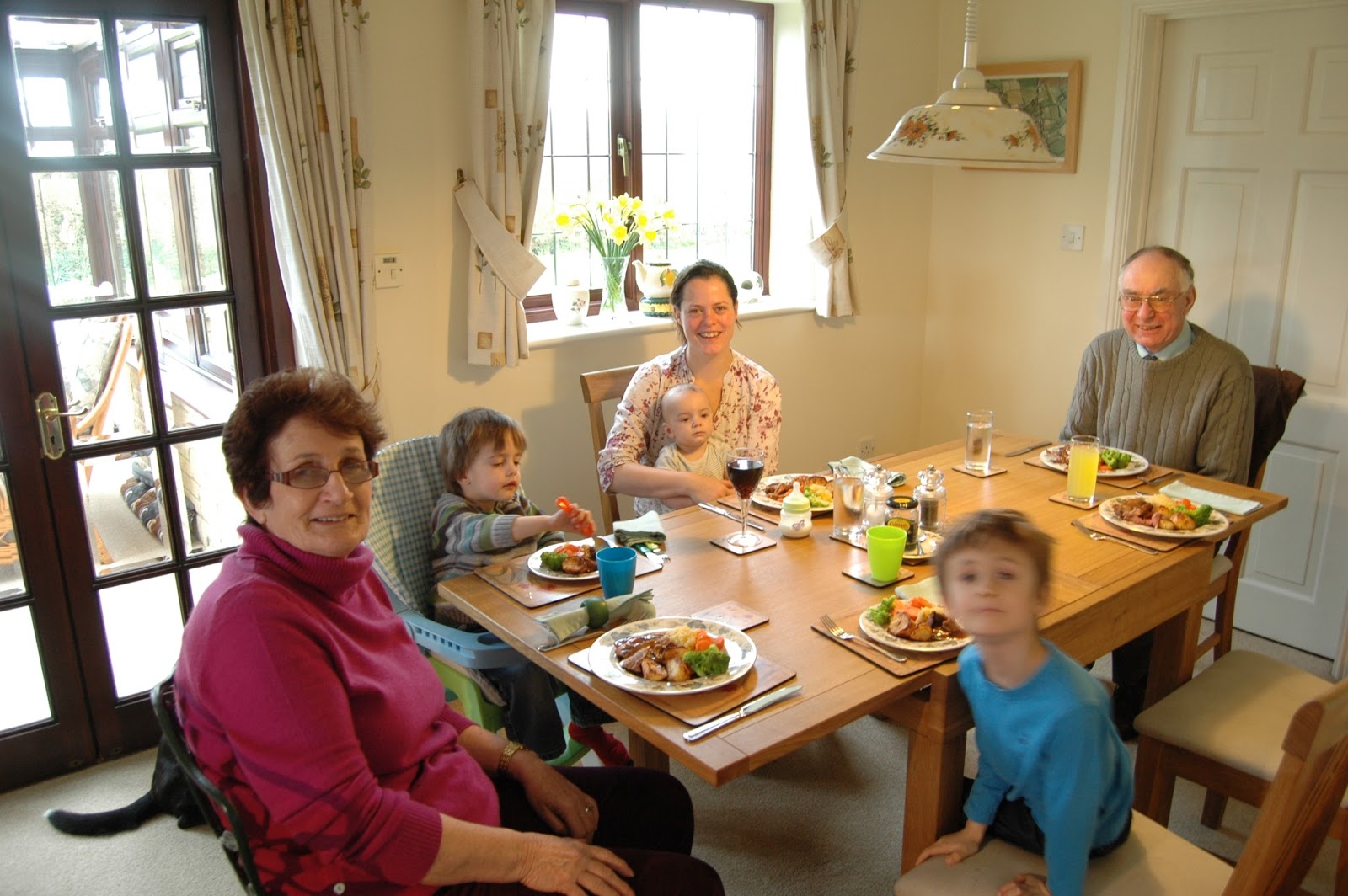
My little family about to enjoy a roast!

Tuesday, 19 March 2013

Easter recipes #1

Slow roasted belly of pork infused with thyme and garlic, on a coarse grain mustard mash with a cider and apple jus. 

With Easter soon approaching it's time to start thinking about what to cook. This blog will come in two parts, the first being a roast you can put in the oven and leave to do it's thing for a few hours giving you more time with your family. The second will be a bit more hands on needing a bit more attention. The first recipe will be a belly of pork dish. This cut of meat needs a slow cooking process and a low heat then to finish it off it needs a hot blast in the oven to crisp it up giving you perfect crackling.
Photo courtesy of Wiltshire Society magazine (from a recipe feature I was in)
Ingredients
(Serves 4)
1 kg of pork belly
1 bunch of thyme
2 garlic cloves
6 medium maris piper potatoes
1 tbsp coarse grain mustard
1 knob of butter
1 large onion diced
1/2 pint of cider
1/2 pint good quality beef stock (thickened)
2 tbsp chunky apple sauce
100g salt crystals
Pepper for seasoning
Olive oil

Method
First if it's not tied tie up the belly of pork into a joint, then stuff the thyme and sliced garlic clove into the joint. Then pour boiling water over the belly, this helps to dry it out and give perfect crackling. Drizzle some olive oil over the belly and cover with the salt. Place some of the diced onion onto a roasting tray and put the belly on top. Cover with foil and roast in an oven at 150C for 3 hours. After 3 hours remove the foil and brush off the salt and cook for a further 30 minutes at 220C.
To make the mash peel and dice the potatoes, boil until tender then mash. Add the butter, mustard and season.
To make the sauce fry the remaining onions in a sauce pan with some chopped garlic. After 1 minute add the cider and let it reduce by half. Add the apple sauce and stock, reduce by 1/3 and season.
Slice the belly into 'steak' size and serve on the mash with the sauce around it, serve and enjoy!

Tuesday, 12 March 2013

Individual Beef Wellingtons

The Beef Wellington (not named after the 1st Duke of Wellington, it was apparently invented for a civic reception in Wellington, New Zealand) is a very famous and decadent dish. There are many variations and mine is an adaption of Gordon Ramsey's where he uses Parma ham around the fillet opposed to a crepe, which helps to keep the moisture away from the puff pastry. Instead of using a whole fillet of beef (a bit expensive and you'd need 8 hungry mouths) this recipe is for individual steaks. It's quite a simple recipe so give it a go you'll be glad you did! I served mine on dauphinoise potatoes with purple sprouting broccoli and a red wine reduction.

Ingredients (serves 4)
For the Wellingtons:
4 8oz fillet steaks
250g ready made puff pastry
6 chestnut mushrooms
1/2 red onion finely diced
Handfull of washed spinach
2 gloves of crushed garlic
4 slices of Parma ham
1 sprig of thyme
1 egg beaten
For the dauphinoise potatoes:
4 maris piper potatoes
1/2 red onion sliced
1/2 pint double cream
1 garlic glove crushed
For the red wine reduction:
1/4 of an onion chopped
1 garlic clove crushed
1 pint quality beef stock, thickened
1 glass of red wine
2 tbsp red currant jelly
12 purple sprouting broccoli stems

Method
First take your steaks out of the fridge and let them get to room temperature. Splash a bit of olive oil into a frying pan and get smoking hot, seal the steaks and set aside. Pour some of the red wine into the pan to
de-glaze it and lift up the intense steak flavours left over from the sealing process, keep this liquid. Finely chop the mushrooms and fry them in a pan with the onion, thyme and garlic, when it's cooked (after 2 mins) add a splash of red wine and the spinach and keep cooking until the spinach has wilted, season. Roll out or unroll the pastry on a floured surface and let it get to room temperature (makes it easier to work with). Instead of covering the entire steak in pastry we're going to make a lattice effect with the pastry. You can buy a small roller that does it for you but it can easily be done with a knife:

 
Using a knife measure out the width of each steak and measure it out on the pastry and cut it into a rectangle. Then with a sharp knife cut through the pastry like the picture above. When you've done this gently stretch out the pastry like the picture below:


Top each steak with the fried mushroom and onion mixture (duxelle) and wrap them in the Parma ham. Then carefully lay the pastry over each steak and tuck the pastry underneath and brush with the beaten egg:


The Wellingtons are now ready for cooking and can be stored in the fridge for around 12 hours if needed to. Now it's time to make the dauphinoise potatoes, peel and thinly slice the potatoes. Fry the sliced onions in a little olive oil for a minute then add the garlic and double cream. Then add the potatoes and bake in an oven proof dish at 220C for half an hour or until a knife slides easily through the potatoes.
For the sauce fry the chopped onions for a minute in a little olive oil then add the garlic and red wine. Simmer this mixture for 3 minutes to burn off the alcohol then add the stock and redcurrant jelly. Leave to simmer until it reduces by half.
Cook each Wellington on a greased baking tray at 220C, when the pastry is golden brown then they are medium rare and ready! If you prefer your steaks cooked a little more turn the oven down to 175C and add a further 3 minutes for medium or 7 for well done. Boil some water in a pan and cook the broccoli, once it comes back to the boil add 2 minutes and it's cooked. Place the potatoes in a circular cake cutter in the middle of a plate, pour the sauce around the potatoes put the Wellington on top and place the broccoli on the plate. Now you're ready to impress! Good luck and have fun......


Monday, 25 February 2013

How to make a tasty burger

Homemade burger topped with Gruyere avocado and mayo served with fries. 
Since the horse meat scandal local butchers have seen a huge increase in sales with people not trusting the big super markets which is great news for local business. Ready made super market burgers have seen a big dip in sales for obvious reasons. Burgers are super easy to make and there are an unlimited variations all you need is a binding agent (egg and/or bread crumbs) and your'e off! The recipe below is one of my favourites and used to feature on the menu in various pubs I have worked in in the past.
Ingredients:
300g lean mince beef
1 egg
2 tsp ketchup
1 tsp mustard (I used Dijon but any will do)
1/2 red onion diced
1 garlic glove crushed
1/2 tsp cumin
2 tbsp chopped flat leaf parsley
Salt and pepper for seasoning
Method:
First mix all the ingredients in a bowl, to mix really well squeeze it all through your fingers (if you wear a ring I'd take it off!). When it's all mixed really well shape them into patties, to do this form some of the mixture into a ball a bit smaller than a tennis ball then flatten it. Leave them to chill in a fridge for at least 20 minutes so they firm up. The longer you leave them the better as this allows the flavours to enhance. To cook get a frying pan hot with a splash of oil. Cook on each side for about 2 minutes then under a grill for another 5. You can use steak mince to make you burgers and if you do then you can have them medium rare or well done etc., which ever is your preference. Serve in a toasted bun with what ever topping you like. We had Gruyere cheese with avocado and mayonnaise and a side of fries. Enjoy! (No horse meat was used in the making of this burger)

Tuesday, 5 February 2013

Pan fried Bream on chilli and chorizo risotto

Last weekend I catered for a party in the Costwolds and on my way there I decided to give Stroud market a go and see how much of my ingredients I could get from it. Well it turns out Stroud market is a bit good and I managed to get most of my ingredients from Gilt headed bream to various cured meats and locally produced cheeses. I liked it so much that I got some ingredients for myself and here's what I did with them.
Fillet of bream on a chilli and chorizo risotto with beer battered scallops and balsamic reduction
Ingredients: (serves 2)
1 whole bream scaled and gutted
8 scallops (roe removed)
1 cup of risotto rice
Splash of white wine
1 pint of fish stock (or cube, see below if you want to make your own)
10 slices of chilli and garlic chorizo
1/2 red onion finely diced
1/2 green chilli finely chopped (seeds removed)
1/2 green pepper sliced
3 garlic gloves finely chopped or through a garlic crusher
1 knob of butter
Beer batter (lager mixed with self raising flour-the consistency should be thick enough to cover the back of a spoon)
1/2 pint of vegetable oil
Balsamic reduction
Salt and pepper for seasoning.

Method
First remove the two fillets from the bream. You can ask your fish monger to do this for you but ask for the carcass if you want to make your own stock. To make a fish stock fill a pan with cold water add the fish and any root vegetables you have to hand, a few garlic cloves and fresh parsley if you have any. Slowly bring the pan up to simmering point and simmer very gently for about an hour. Strain this through a very fine sieve or muslin cloth if you have one. To get perfectly clear fish stock freeze it then defrost it through a muslin cloth.
To make the risotto firstly fry the slices of chorizo with a little olive oil then add the rice making sure that each grain get covered in the olive/chorizo oil. Then add the onions, garlic, chilli, pepper and white wine. Simmer the wine so it burns off it's alcohol. Pour in the fish stock and let it simmer, when the rice is cooked add the butter, season and set aside with a lid on it. Dip the scallops in flour then into the batter, in a sauce pan carefully heat up some vegetable oil. Season the fillets of bream and heat up some butter and olive oil in a frying  pan. When it's bubbling cook the bream, skin side up first. Cook for about 2 minutes on each side spooning the oil from the pan over the fillets as you cook them. As they are cooking test the heat of the vegetable oil by dropping a bit of the batter in, if it starts bubbling then it's ready. Cook the scallops for about a minute then drain on kitchen paper. To plate I used a circular cake cutter for the risotto, then placed the fillet on it, poured some balsamic reduction around the risotto and placed the scallops on that, as you can see from the photo! Give it a go and bon appetit!


Saturday, 22 December 2012

Wiltshire food producers - Bush Farm Bison Centre

Local food producers are my heroes. It takes a lot of effort and determination to get a product out into the market when all the big corporations are swamping us with their cheap deals and special offers. (A short rant which is now over).
I recently paid a visit to Bush Farm Bison centre in Wiltshire (http://www.bisonfarm.co.uk/index.htm) where I met the very friendly and informative Colin Seaford and his wife Pepe. Colin has had an interest in Bison since a young age and now has over 74 on his secluded farm that is open to the public in the summer months. They also have elk, red deer and prairie dogs!
One of Colin's impressive Bison
Bison are big, big and fast. They are built more like a horse than cattle and on a sprint start they can out run a  horse. All the Bison were in from the fields kept in yards sorted by age, I was a little bit nervous when Colin suggested we go into one of the yards to get a better look. We toured round 3 different yards the last one containing the biggest Bison (not that my back catalogue of Bison is that big - my dad and I crept quite close to one to get a picture in Yellowstone Park in the US). He was massive towering over the rest of the Bison and apparently weighed in at over a ton. 'He's alright' said Colin 'but I wouldn't trust him. She's a nice Bison I can get quite close to her' pointing out a rather impressive female, 'That one however, I would trust her at all, she once chased me on my quad bike out of a field. She was gaining so much ground on me that when I got to the gate I had to jump off the bike straight over it!' Bison aren't for milking then? 'Why would you want to get near an armed animal?' Wise words indeed.
The one not to trust!
One thing Colin was adamant about is that Bison meat does not fall under the 'exotic meats' category. Bison once roamed all over Europe and when Britain became an island they were hunted to extinction. The meat itself has a sweeter flavour than beef, it's not gamey or wild tasting. Bison carry very little fat and the meat has no marbling unlike beef or lamb, it is very high in protein and lower in fat, cholesterol and calories than most other meats. With less than 50 calories per ounce Bison meat has been used by several weight loss programmes.
I came away with two sirloin steaks and really wanted to do them justice and rather than have steak and chips. So after racking my brain I came up with a dish that would compliment the Bison.  
Sirloin of Bison
The Bison meat doesn't take much cooking and we had ours rare. I served it on sweet potato mash with wilted spinach, caramelized baby beetroot, oven roasted baby carrots, parsnip crisps and a red wine and redcurrant jus. It was without doubt one of the tastiest steaks I've ever had (on par with kangaroo fillet) and now I'm a big fan. I would definitely recommend a trip to Bush Farm Bison centre and whilst you're there get some meat. All purchases come with a leaflet with Bison cooking tips and some information about the animals, their sirloin is so good that it won the Guild of fine foods three star award in 2011 and 2012. Just don't get too close to the Bison!